
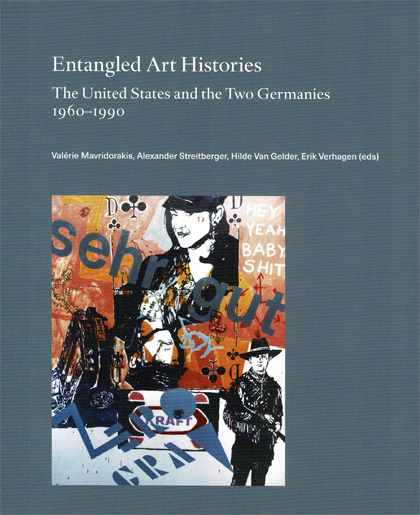
Throughout the Cold War era, a sustained and intense dialogue developed between both the West and East German and the North American art scenes on artistic, socio-cultural, institutional and economic levels. Entangled art histories offers new insights into the complex and intertwined transatlantic networks that gradually emerged in the wake of movements such as Pop Art, Minimalism and Conceptualism, involving artists, museums, galleries, curators, critics, and the art market.
The essays in this volume, written by internationally renowned scholars, address key issues ranging from travel and infrastructure to East-West cultural policy during the Cold War. By exploring the exhibition strategies, controversial receptions and geopolitical concerns of these entangled histories, this book contributes to a better understanding of the dynamic interplay between artists, galleries, and museums from a transnational perspective.
(4e de couv.)
Table of contents
- 7 Preface
- 11 Introduction
Valérie Mavridorakis - 23 Rauschenberg's Bed (1955) and II. Documenta. Histoire croisée of a Transatlantic Conundrum
Gregor Stemmrich - 47 "If it is possible, it is best if You bring Your work Yourself": infrastructure, logistics, and production at documenta
Felix Vogel - 63 Artists, critique, and the New York-Cologne axis in the 1980s and 1990s
Alexander Alberro - 79 Must art hang? Critical ambivalence in Andrea Fraser's exhibitions at galerie Christian Nagel
Alexander Streitberger - 103 Think-crazy. Charles Simonds's exhibition at Jürgen Schweinebraden's EP Galerie in East Berlin: notes on a cooperation between a private art institution in the GDR and the DAAD Artists-in-Berlin program in West Berlin
Nóra Lukács - 121 Belated recognition: critical reception of East German art in the United States around 1990
Gregory H. Williams - 133 Franz Erhard Walther in New York
Erik Verhagen - 147 Schütte's Amerika (1975). A Nietzschean critique of US Conceptualism in Düsseldorf
Stefaan Vervoort - 165 Between Rhine-Ruhr and Rust Belt: industrial transnationalism in Reinhard Mucha's The Wirtschaftswunder, to the people of Pittsburgh
Althea Ruoppo - 183 Charles W. White in East Berlin: progressive art history and the limits of socialist solidarity in the German Democratic Republic, 1951-1978
Claudia Mesch - 197 Network as an expansion strategy: Robert Barry and the development of artist relations of galerie Paul Maenz in Cologne
Stefano Agresti - 213 Infrastructural economies in Post-Conceptual film practices of the 1970s and 1980s: the example of the Neo-Narrative essay film
Sabeth Buchmann - 229 Post-Gulf war specifications in the German-US art exchange from a Munich perspective, 1996-2001
Dirk Snauwaert - 241 Plates
- 257 About the authors