
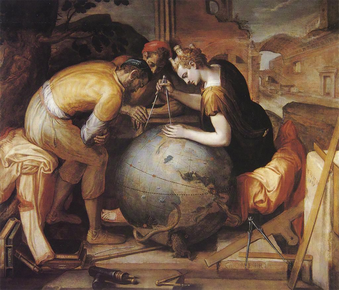
« [...] non ci è cosa al mondo che meglio possa rappresentare tutte le cose dal grande Iddio prodotte, che la pittura istessa »
Ulisse Aldrovandi, Avvertimenti del dottore Aldrovandi all'Ill.mo e R.mo Cardinal Paleotti sopra alcuni capitoli della pittura, 1581
« On dirait que le monde est à peine plus âgé que l’art de faire le monde »
Paul Valéry, Variété I, 1924
« [...] le monde est tout ce qu’on peut en dire »
Francis Wolff, Dire le monde, 1997
The fifteenth and sixteenth centuries are commonly regarded – at least since Jacob Burckhardt's seminal work1 – as the age of Europe’s “discovery” of the “New World” or the “Other World”, according to a sometimes simplistic view that has undergone significant critical reinterpretation in recent decades2. This was an age that saw the development of a new “image of the world”3 and, at the same time, the advent of the first “globalisation"4 and the ensuing “unsettlement of the world"5.
A new world “system” was emerging, Copernican heliocentrism, which would establish itself at the turn of the 17th century as an “objective” alternative to traditional geocentrism, marked by a biblical interpretation of the world and the universeA new world “system” was emerging, Copernican heliocentrism, which would establish itself at the turn of the 17th century as an “objective” alternative to traditional geocentrism, marked by a biblical interpretation of the world and the universe6. This was also the time of Giordano Bruno’s hypotheses about “multiple worlds” or “infinite worlds"7, which paved the way for alternative representations of the universe, its laws and what Galileo would call the “costituzione del mondo”, the “constitution of the world8. Furthermore, within cosmography itself, we see the emergence and subsequent autonomisation of geography, which now devotes itself exclusively to describing the world here-below, leaving the cosmos to astronomers. Geography truly becomes a field of knowledge about the world, distant from Heaven and theology.
Were not the fifteenth and sixteenth centuries also the moment when the liber mundi – the “book of the world” or “book of nature”, a metaphor referring to the observable whole of divine creation – seemed to be gradually being described and interpreted in its entirety9? The moment, once again, when humanity is still regarded as a microcosm – a “small world” according to Pico della Mirandola10, an “aultre monde” according to Rabelais11, in the image of the universe – and often described as the “centre of the world”, while the work of art is thought of as a “new world” by Federico Zuccaro and the world itself as a “grand tableau” by Francisco de Holanda12.
In any case, the Renaissance appears to be that moment in history when a new way of thinking about what we commonly refer to as “the world” began to take shape. However, it is impossible to measure its historical ins and outs without defining what the world is, what we mean by this word which, during the Renaissance, had a long history but whose meanings were constantly changing13.
For the world refers to a multifaceted reality: physical, cosmological, symbolic, existential, political, and social; it is both a given and a construct. It can refer to the world we inhabit (oikoumene) and transform, seek to understand, imagine and represent. But the world is also the entire universe, cosmos or universe as an ordered whole.
It refers sometimes to what surrounds and frames human beings — an environment, a horizon, a scene — and sometimes to a form of existence: a world is then what makes possible a certain way of being, thinking, acting, living, and relating to others. It is also the social space to which we belong, with its norms, languages and images, forming a unique universe, a separate society, a parallel or alternative reality.
More broadly, the world can also be an age, an era, an order or disorder, a whole or a part of... It can be seen as a work, a structure, a narrative, an experience, or even a mental projection — a collective or individual imagination.
The world is what we inhabit — and therefore what we seek to understand, represent, and even transform.
Therefore, rather than considering the world as a given or self-evidencing fact, we wish, on the contrary, to question its foundations and meanings in order to better understand its nature.
To this end, in addition to historical research and the rich historiography on the Renaissance world, we cannot do without critical reflections and theoretical tools from our contemporary world — whether it be Heidegger’s notion of Weltlichkeit14 (“worldliness”), the contributions of Michel Foucault (notably Les Mots et les choses, 1966)15, Maurice Merleau-Ponty (notably La Prose du monde, 1969)16, Nelson Goodman’s ways of making worlds17, the power and limitations of words in imagining and “describing the world” (Francis Wolff)18 or, in an anthropological sense, the processes of “worlding” or “composition of worlds” proposed by Philippe Descola19.
Conference themes
At a time when the contours of the known are being redefined, images — whether they relate to knowledge or are mental, poetic or artistic — are becoming privileged mediations, complex operators of knowledge and enunciation of the world.
This symposium aims to examine how the world is constructed and expressed through images, studying how they describe, organise and transform human — and possibly non-human — experience. The approach is resolutely interdisciplinary, combining perspectives from art history, the history of knowledge, philosophy, visual anthropology, and the history of technology and beliefs.
***
Rather than structuring this call around pre-established categories of objects or visual devices — whether illustrated books or illuminated manuscripts, geographical or nautical maps, frescoes and murals, sculptures or reliefs, celestial or terrestrial globes, ephemeral or festive decorations, scientific objects such as clocks, astrolabes or automata, but also anatomical or botanical plates, engravings, prints, architectural drawings, narrative tapestries, liturgical objects, iconographic coins or medals, and even theatrical devices or artefacts from cabinets of curiosities —, we propose to reflect on how images actively participate in the cultural construction of a world.
This reflection is based on a series of formal, symbolic and theoretical tensions, conceived as flexible heuristic frameworks, which open up a space for analysis where images are not simply passive witnesses to reality, but major players in its construction, organisation and questioning.
- The world as a universe: order and scale
Large/small; macrocosm/microcosm; south/north; east/west; infinite/finite; space/time; habitable/hostile; order/chaos; nature/culture; celestial/terrestrial; finite/eternal. - Places in the world: spaces, territories and spatial relationships
Near/far; centre/periphery; local/global; urban/rural; oriented/disoriented; boundary/continuity; mobility/fixity; public/private; built/natural. - The world and its temporalities: histories, narratives and rhythms
Origin/end; past/present; cyclical/linear; memory/forgetting; permanence/rupture; historical/mythical; simultaneity/succession; ancient/modern; archaic/new; providence/chance. - Visible worlds, invisible worlds: perceptions, apparitions, visions
Visible/invisible; surface/depth; real/imaginary; objectivity/subjectivity; light/darkness; veiled/unveiled; presence/absence; transparency/opacity. - The body of the world: beings and living things
Human/non-human; living/inanimate; embodied/disembodied; animal/human; natural/artificial; healthy/sick; organic/mechanical; flesh/spirit; body/soul. - Knowledge, languages and representations of the world
Language/languages; science/belief; scientific/popular; objectivity/subjectivity; norm/deviation; observation/speculation; rationality/emotion; visible/sayable; world/unworldly.
These tensions can be seen both in expected objects and in forms neglected by historiography, offering fertile ground for exploring the many ways in which the world was depicted in images during the Renaissance.
This international symposium is intended for publication, following review of the manuscripts by the scientific committee.
Submission guidelines:
Proposals for papers must be written in French or English and include the following information:
- a title;
- a summary of the communication project in a few lines;
- a suggested bibliography comprising a maximum of six publications
- an academic curriculum vitae or a brief biographical and bibliographical note
angele [dot] tence
 cnrs [dot] fr (angele[dot]tence[at]cnrs[dot]fr), etienne [dot] bourdonuniv-grenoble-alpes [dot] fr (anaelle[dot]rossi[at]univ-grenoble-alpes[dot]fr) and patrizia [dot] cellivillamedici [dot] it (patrizia[dot]celli[at]villamedici[dot]it)
Coverage:
Accommodation and meals are provided by the organising institutions. However, participants are responsible for their own travel expenses.
Organizing committee:
- Étienne Bourdon (Université Grenoble Alpes, LARHRA / UMR 5190)
- Guillaume Cassegrain (Université Grenoble Alpes, LARHRA / UMR 5190)
- Florian Métral (CNRS, Centre André-Chastel, CPJ Arvigraph)
- Anaëlle Rossi (Université Grenoble Alpes)
- Angèle Tence (CNRS, Centre André-Chastel)
- Alessandro Gallicchio (Académie de France à Rome – Villa Médicis)
- 1Jacob Burckhardt, Die Kultur der Renaissance in Italien (1860), translated in French: La Civilisation de la Renaissance en Italie, Paris, Albin Michel, 1955.
- 2John R. Hale, The Civilization of Europe in the Renaissance, Londres, HarperCollins, 1993, translated in French: La Civilisation de l’Europe à la Renaissance, Paris, Flammarion, 1995. See also Surekha Davies, Renaissance Ethnography and the Invention of the Human: New Worlds, Maps and Monsters, Cambridge, Cambridge University Press, 2016. Romain Bertrand (ed.), L'exploration du monde. Une autre histoire des grandes découvertes, coord. Hélène Blais, Guillaume Calafat, Isabelle Heullant-Donat, Paris, Éditions de Noyelles, 2020.
- 3Jean-Marc Besse, Les Grandeurs de la Terre. Aspects du savoir géographique à la Renaissance, Paris, ENS Éditions, 2003 ; Etienne Bourdon, Croire et savoir. L'invention du Monde à la Renaissance, Paris, Les Belles Lettres (in preparation).
- 4Serge Gruzinski, Les Quatre Parties du monde. Histoire d’une mondialisation, Paris, La Découverte, 2004.
- 5Elizabeth Horodowich and Alexander Nagel (ed.), Amerasia, New York, Zone Books-Princeton University Press, 2023.
- 6Alexandre Koyré, Du monde clos à l’univers infini, Paris, Gallimard, 1957; Robert S. Westman, The Copernican Question: Prognostication, Skepticism, and Celestial Order, Berkeley, University of California Press, 2011; Lorraine Daston and Peter Galison, Objectivity (2007), translated in French: Objectivité, Dijon, Presses du réel, 2012.
- 7Giordano Bruno, De l’infini, de l’univers et des mondes (1584). See Frances A. Yates, Giordano Bruno et la tradition hermétique, Paris, Éditions du Cerf, 1997 (French translation of Giordano Bruno and the Hermetic Tradition, 1964).
- 8Galilée, Dialogue sur les deux grands systèmes du monde [Dialogo sopra i due massimi sistemi del mondo, 1632], transl. by René Fréreux, Paris, Seuil, 1992, “Dédicace au grand-duc de Toscane”, 27, p. 39.
- 9Peter Harrison, The Bible, Protestantism, and the Rise of Natural Science, Cambridge University Press, 1998.
- 10Jean Pic de la Mirandole, Commentaire sur une chanson d’amour de Jérôme Benivieni, chapter XII, Paris, Guy Trédaniel Éditeur, 1990.
- 11François Rabelais, Pantagruel, Lyon, Claude Nourry 1532, chapter VIII, f° Diiii r.
- 12Michel Jeanneret, Perpetuum mobile: métamorphoses des corps et des œuvres, de Vinci à Montaigne, Paris, Macula, 1997; Florian Métral, Figurer la création du monde. Mythes, discours et images cosmogoniques dans l'art de la Renaissance, Arles, Actes Sud, 2019.
- 13Étienne Bourdon, Croire et savoir. L'invention du Monde à la Renaissance, Paris, Les Belles Lettres (in preparation).
- 14Martin Heidegger, Être et Temps (Sein und Zeit), transl. by Emmanuel Martineau, Paris, Gallimard, 1985 (first ed. 1927) and Martin Heidegger, L’Origine de l’œuvre d’art, dans Chemins qui ne mènent nulle part, transl. by Wolfgang Brokmeier, Paris, Gallimard, 1962, p. 35-105 (first ed. 1950).
- 15Voir Christophe Premat, « Michel Foucault & la phénoménologie », Acta fabula, vol. 23, n° 5, Éditions, rééditions, traductions, Mai 2022, URL : http://www.fabula.org/revue/document14470.php, consulted on June 2, 2025.
- 16Maurice Merleau-Ponty, La Prose du monde. [Posthume], ed. by Claude Lefort, Paris, Gallimard, 1969.
- 17Nelson Goodman, Manières de faire des mondes, transl. by Jacques Morizot, Paris, Éditions Jacqueline Chambon, 1992 (first ed. 1978).
- 18Francis Wolff, Dire le monde, Paris, Presses Universitaires de France, 1997.
- 19Philippe Descola, Les formes du visible. Une anthropologie de la figuration, Paris, Seuil, 2021; Philippe Descola, Politiques du faire-monde, Paris, Seuil, 2025.