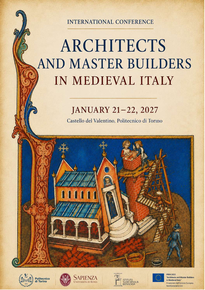
International conference, 21-22 January 2027
The conference aims co update our knowledge of architects and master builders active in Medieval Italy. From the eleventh century trhrough the Gothic period, ltaly represented a major arena for the development and evolution of the architect's role within the broader European context. It was in ltaly, in face, that written sources first recorded some of the most celebrated master builders of the Romanesque age, such as Buschero in Pisa and Lanfranco in Modena - figures who emerged from the traditional anonymity of construction workers and distinguished themselves as highly skilled professionals. This development took place within the framework of the communal civilizarion, where civic institutions promoted public works and recognized the dignity of labor in service to the urban community.
During the thirteenth and fourteenth centuries, narrative, epigraphic, and administrative sources allow us to trace developments in the building sector and to identify the most renowned mastrers who shaped the history of architecture in ltaly. New professional figures also emerged during these centuries, including engineers, hydraulic specialists, and experts in civil and military architecture, active in the communes, the Papal States, and the Norman, imperial, Angevin, and Aragonese territories of southern ltaly. Taken together, these experiences make Medieval ltaly a privileged observatory wichin the European framework for understanding both the collective organisation of construction labor and the emergence of the architect as a professional figure, characterized by technical expertise, theoretical knowledge, social standing, and relationships with political power.
The conference seeks to foster reflection on these themes within an international perspective, encouraging dialogue among scholars from different disciplines, including not only architectural and art history, but also economic, military, literary, archaeological, and cultural history.
The chronological scope of the conference excends from the sixth to the fourteenth century. Papers will be organized into the following thematic sections:
- The Archicect as a Professional Figure:
technical and supervisory roles on the building site; education and training; iconographic representations; social recognition and public prestige. - The Names of the Architect:
terminology in medieval Latin and vernacular sources; technical distinctions; cultural relationships with classical tradition, theology, scholastic philosophy, and early ltalian literarure. - The Architect's Tools:
working and design instruments; drawing and methods of representation. - Professional Roles in Building Industry:
organization of construction sites; master masons, stonecutters, carpenters, surveyors; the rise of engineers in military and civil works. - Master Builders in Medieval Sources:
administrarive records, epigraphic evidence, masons' marks, and narrative sources; building guilds in the society and economy of the Italian communes. - Master Builders and Material Culture:
reconstructing the activity of organized groups, including anonymous ones, through the comparative study of masonry, materials, techniques, and building forms. - Italy in the International Context:
investigations and comparisons between architects active in Italy and comparable professional figures documented in Christian Europe, the Byzantine Empire and the Islamic world.
The conference will feature both invited speakers and speakers selected through this call for papers. Scholars interested in
parcicipating are invited to submit their proposals to the Scientific Commitee (archimed polito [dot] it (archimed[at]polito[dot]it)) by 30 September 2026. Proposals should consist of an abstract of no more than 2.000 characters and a brief CV of no more than 1.000 characters, combined in a single file and indicating the relevant thematic section.
Presentations will be approximately 20 minutes in length. Applicants will be notified of the outcome of the selection process by 30 Occober 2026. Authors whose proposals are accepted must confirm their participation by sending an email to archimedpolito [dot] it (archimed[at]polito[dot]it) no later than 20 November 2026.
The conference organizers will provide lunches and coffee breaks for all selected participants but will not be able to cover travel or accommodation expenses.
Following the conference, speakers will be invited to submit their papers for publication in an edited volume. Contributions
will undergo a peer-review process. Final manuscripts must be submitted by 31 May 2027, and publication of the volume is
planned by the end of the year.
Official langages: Italian, English and French.
Proposal submission deadline:
30 September 2026
Notification of acceptance:
30 October 2026
Registration deadline:
20 Novembber 2026
SCIENTIFIC COMITTEE
- Carlo Tosco, Policecnico di Torino (chair)
- Valerio Ascani, University of Pisa
- Xavier Barral i Altet, Institut National d'Histoire de l'Art, Paris
- Giovanni Coppola, Suor Orsola Benincasa University of Naples
- Kai Kappel, Humboldt-Universität, Berlin
- Dany Sandron, Sorbonne Université, Paris
- Amadeo Serra Desfilis, Universiry of Valencia
- Guglielmo Villa, Sapienza University of Rome
Poticecnico di Torino, Interuniversity Department of Regional and Urban Studies and Planning
viale Mattioli 39, 10125 Torino, ltaly
Info: archimedpolito [dot] it (archimed[at]polito[dot]it)
The conference is organised within the framework of the National Research Project of Relevant Interest
"Architects and Master Builders in Medieval Italy'' - Call 2022 Prot. 2022YXESH7
Funded by the European Union
NextGeneracion EU.