
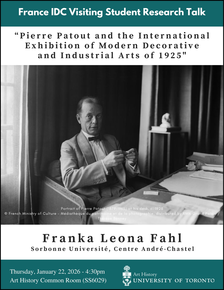
Conférence de Franka Fahl, invitée par l'Université de Toronto, jeudi 22 janvier 2026 de 16h30 à 17h30 (heure locale)
Pierre Patout (1879–1965), who graduated from the École des Beaux-Arts in 1903, is considered one of the protagonists of an architectural approach that, as Professor Emeritus Gilles Ragot has noted, has long challenged attempts at strict stylistic classification. Contemporary historiography situates Patout’s work within a modernité raisonnée (Foucart, 1998), commonly associated with Art Deco, a style embodying a distinct conception of luxe à la française.
This position is particularly evident in Patout’s contributions to the 1925 Paris Exposition, for which he realized five projects: the Porte de la Concorde; the Manufacture nationale de Sèvres pavilion, designed with André Ventre; the Nacrolaque pavilion; electrical transformer buildings for the Compagnie Générale d’Électricité; and the celebrated Hôtel du Collectionneur, conceived under the artistic direction of his close collaborator Jacques-Émile Ruhlmann. Through these works, Patout translated French traditions and cultural references into a modern architectural language, articulating a vision of national identity that closely reflects the cultural and aesthetic aspirations of France in 1925.