
Study day organised by the Centre André-Chastel, The Centre national des arts plastiques and the Espace de l’Art concret
In 2022, the Centre André-Chastel (Sorbonne University), the Centre national des arts plastiques and the Espace de l'Art Concret in Mouans-Sartoux launched a research programme dedicated to concrete art, with the aim of diversifying perspectives on this major movement in 20th century abstraction. After three study days linking concrete art to nature, graphic design and the universal, this fourth edition examines the place of relationships, feelings and other forms of love among concrete artists and poets, as well as their successors.
This approach takes the opposite view to the statements made in the April 1930 issue of the review Art Concret. According to the manifesto, painting no longer owes anything to “sentimentality” and “sensuality” but everything to the intellect: "The work of art is not created by the fingers, nor by the nerves. Emotion, feeling and sensitivity have never advanced art towards perfection. Only thought (intellect), with a speed undoubtedly greater than that of light, creates.” Further on, an insert lists “A few words not related to painting”, including: “sensitivity”, “emotion”, “poetry”, “personality”, “intimate”, “human”, “desire”, “passionate”, “heart". These are all entry points to a deeper understanding of one of the terms in Jean Hélion's “formula” for painting: “A lot of geometry for the eyes / A little humanity for the heart.”
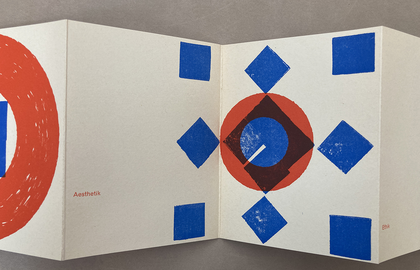
On the basis of this nuance, artists, researchers, curators and collectors are invited to shed light on how concrete artists have constructed, in art as in life, a new balance between “passion and reason”, according to the title of Warja Lavater's leporello chosen for this study day. The day begins with an exploration of the dynamics that drive concrete artist couples who have worked together or side by side, as well as how contemporary artists revisit them. Certain manifestations of concrete poetry, which embrace surprising sentimentality, sensuality and even eroticism, and are sometimes the subject of current controversy, are also studied. Learning communities, linked by relationships of transmission and animated by the various transmitters of concrete pedagogy, are then explored. Finally, the ability of certain concrete practices to forge human relationships on different levels, sometimes micro-political, sometimes geo-political, is examined in the light of Brazilian neo-concretism and the practice of a contemporary artist.
This day is preceded by a special evening event which brings together prominent figures from the art world: they are invited to answer a lover’s questionnaire about concrete art.
Scientific Organizers
- Isabelle Ewig, Associate Professor of Contemporary Art History, Sorbonne University
- Hélène Meisel, Professor of Theory and History of Art, École européenne supérieure d’art de Bretagne, Rennes
Scientific Board
- Aude Bodet, Head of the Section Collection, Centre nationale des arts plastiques
- Isabelle Ewig, Member of the Centre André-Chastel
- Fabienne Grasser-Fulchéri, Director of the Espace de l’Art Concret
PROGRAM
Friday, 20 February 2026: Introducing Evening
- 6 p.m. Lover’s Questionnaire about Concrete Art
Conducted by Isabelle Isabelle Ewig and Hélène Meisel
With Cécile Bart, Artist, Jean-Philippe and Françoise Billarant, Collectors, Serge Lemoine, former Professor at Sorbonne University, Director of the Grenoble Museum and President of the Musée d’Orsay
Saturday, 21 February 2026: Study Day
- 8.45 a.m. Welcome of participants
- 9 a.m. Introduction to the study day by Isabelle Ewig, and Hélène Meisel
Living Community, Working Community
- 9 a.m. Concrete Couples: Outline of a Methodoloy
by Isabelle Ewig - 10 a.m. (Post) Modern Lovers
by Karina Bisch and Nicolas Chardon, artists - 10.30 a.m. Discussion and break
Langages of Love
- 11 a.m. Concrete Poetry and Love Constellations
by Agathe Mareuge, Associate Professor in German Studies, Sorbonne University, UR Reigenn - 11.30 a.m. Concrete Poetry / Public Space: The « Las Avenidas » Cotroversy by Eugen Gomringer
by Paul Bernard, Director of the Kunsthaus Biel Centre d’art Bienne (KBCB), Switzerland - 12h a.m. Ellipsis. Pierre Faucheux and Pol Bury: An Associative Lecture
by Catherine Guiral, Professor of Graphic Design and History of Graphic Design, Ésam Caen/Cherbourg - 12.30 Discussion
Passing on: Objects of a Concrete Pedagogy
- 2.30 p.m. Josef Albers’s Relationship with Art (delivered in english)
by Jeffrey Saletnik, Associate Professor of Modern Art, Indiana University Bloomington (USA) - 3.10 p.m. Forms of Transmission chez Warja Lavater
by Hélène Meisel - 3.50 p.m. Gottfried Honegger’s « Le Viseur » : From Thought to Action – Children Depicting Artistic Ideas in Real-Time (delivered in english)
by Camil Hesse, artist-educator (Denmark), Member of the Board of Directors, Espace de l’Art Concret, Mouans-Sartoux - 4.30 p.m.Discussion and break
Weaving Relationships
- 5. p.m. On Neoconcretist Form and Feeling (delivered in english, via videoconference)
by Michael Asbury, Professor of Brazilian Modern and Contemporary Art, Chelsea College of Arts, University of the Arts London - 5.45 p.m.Damien Poulain, artist, in conversation with Isabelle Ewig et Hélène Meisel
- 6.15 p.m. Final discussion and closing of the study day
- 6.45 p.m. Drink of friendship
