
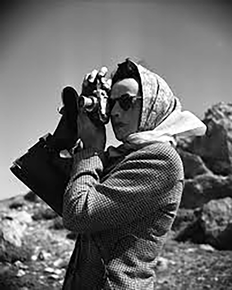
This interdisciplinary and international conference, the first scholarly event devoted to Ré Soupault (1901–1996), will be held in conjunction with the exhibition dedicated to the Franco-German artist at the Strasbourg Museum of Modern and Contemporary Art, running from 21 May to 28 November 2027. The exhibition has been awarded the "Bicentenaire de la Photographie" label.
In 2019, the centenary of the Bauhaus brought renewed attention to the women associated with the celebrated Weimar school of architecture and applied arts, building on a body of publications and events devoted to them since the early 2000s. Ulrike Müller's Bauhaus-Frauen: Meisterinnen in Kunst, Handwerk und Design1, which profiled twenty women artists upon its initial publication in 2009, was subsequently reissued in a revised and expanded edition incorporating, within the chapter "Meisterinnen der Fotografie und der Tagebuchnotiz," a newly recognized figure: Ré Soupault. And yet, her multifaceted and substantial body of work remains largely unknown to this day, particularly within the French-speaking world.
During her studies at the Bauhaus, the artist then known as (Meta) Erna Niemeyer (born in Bublitz/Bobolice, Pomerania) studied under Johannes Itten, Vassily Kandinsky, and Paul Klee. Shortly thereafter, in Berlin, she assisted Viking Eggeling on one of the earliest abstract films and subsequently married the dadaist Hans Richter. Having worked as a fashion journalist and made the acquaintance of Paul Poiret, she established herself as a fashion designer in 1930s Paris, contributed to the popularization of the culotte-skirt and invented the so-called "transformation dress," sold jewelry designed by Elsa Triolet in her boutique-atelier "Ré Sport," and had her collections photographed by Man Ray. Following her meeting with the surrealist Philippe Soupault in 1933, she turned to photography and accompanied him on reportage assignments throughout Europe and in the Maghreb. She was the first woman photographer granted authorization to enter one of Tunis's quartiers réservés and to photograph the women residing there. Following the Second World War, and separated from Philippe Soupault, she pursued a career as a translator, rendering into German authors as diverse as Romain Rolland, Lautréamont, and the surrealists, while also translating from German into French the work of Karl Jaspers, whose philosophy lectures she attended at the University of Basel. Until the late 1980s, she composed numerous radio essays on a wide array of subjects and, together with Philippe Soupault, compiled and translated children's tales whose popularity has endured to the present day.
Throughout the 20th century, Ré Soupault engaged in a multifaceted range of activities, both within and beyond the artistic sphere alone. Her essayistic production in particular – produced for Swiss and German radio as well as for periodicals such as XXe siècle – constitutes a first-hand account of the avant-gardes of the first half of the 20th century, which she observed as a privileged witness and thinker. As an intermediary between German and French culture, she was also part of networks of artists and intellectuals in New York from 1944 onward.
The diversity of her output, her engagement in activities considered minor, and her transnational trajectory partly explain why she remains largely unknown twenty-five years after her death, despite the solo and group exhibitions devoted to her. While women artists, particularly those of the avant-garde movements, have been undergoing academic and institutional rediscovery for two decades, women historiographers of the avant-garde such as Ré Soupault remain marginal figures, as the gender perspective has not yet become sufficiently integrated within avant-garde research (Suleiman 1990, Jones 2004).
This conference, the first to be devoted exclusively to her, seeks to examine the full range of the work produced under the names Ré Soupault, Ré Richter, Renate Green, and Erna Niemeyer, intending to establish her place within European art history and literary history, and within cultural history and the historiography of the avant-gardes. The aim will be to analyze the reasons for her falling into obscurity and to assess her artistic and intellectual contribution to the history of the movements with which she was associated. The originality and multiplicity of her activities within the avant-gardes allow for a critical rereading of these movements, particularly in light of the development of research on the applied arts and material culture (fashion in particular), as well as cultural studies, feminist and gender studies, and transcultural and postcolonial studies (in the case of the photographs she took in one of Tunis's quartiers réservés in 1939).
Contributions drawing on art history (fashion, photography, film), literary studies (German studies, French studies, translation studies), the history of ideas, and inherently interdisciplinary fields (avant-garde studies, gender studies, postcolonial and transcultural studies) might address the following areas:
- her work in film (1923–1925), in relation to Viking Eggeling as well as Hans Richter and Walter Ruttmann, situated within the broader scholarly rediscovery of women's contributions to this field (Lore Leudesdorff);
- her work in journalism (1926–1934), within the domain of fashion, as both author and illustrator for major German periodicals (Sport im Bild, Für die Frau, Die Form), alongside contemporaries such as Helen Hessel and Claire Goll;
- her work in fashion, through her boutique Ré Sport (1931–1934), in which she sought to introduce Bauhaus principles into Parisian fashion;
- her photographic practice (1934–1951), situated at the intersection of New Vision photography and a more humanist idiom, encompassing a substantial body of portraits;
- her work as a translator, from French into German (Romain Rolland, Lautréamont, Philippe Soupault) and from German into French (Karl Jaspers);
- her radio writing, addressing a broad range of subjects within art and literary history, and cultural history more generally (Rabindranath Tagore, Annette Kolb, René Schickele, Celtic culture, witchcraft, the position of women within European and extra-European cultures, Aubusson tapestry, among others);
- her writing, work as a publisher, and translation of children's tales, notably in collaboration with Philippe Soupault.
Certain aspects may warrant more focused study, including:
- her training at the Bauhaus in Weimar (1921–1925) under Itten, Klee, Kandinsky, Muche, Schlemmer, and Gropius;
- her postwar integration into diverse artistic networks, including Bauhaus women (Lore Leudesdorff, Tut Schlemmer, Gertrud Arndt, Lucia Moholy, Anneliese Itten, Nina Kandinsky), contemporaries from the same period (Umbo, Werner Graeff), and women photographers (Florence Henri, Gisèle Freund);
- the manner in which, through her essays for radio and for periodicals (devoted to the Bauhaus, Dada, and surrealism), she constructed an original historiography of the avant-gardes that diverged from the theory of the avant-garde then emerging during the same period (the 1960s–1970s);
- her photo-reportage on refugee camps in Germany during 1950–1951, together with the journal documenting her journey with her Velosolex through a war-devastated Germany;
- the sole photographic exhibition organized during her lifetime, held in 1994 at the Goethe Institut in Paris as part of the Mois de la Photo;
- her autobiography, published posthumously in Germany in 2018 (and in France in 2026);
- her German translation (published in 1990) of Les Champs magnétiques by André Breton and Philippe Soupault—a work first published in Paris in 1919 that has been read alternately as the culmination of Dada or the inception of surrealism—raising the methodological question of how automatic writing might be translated;
- her privileged relationships with certain artists (Viking Eggeling, Kurt Schwitters, who conferred upon her the artistic name Ré, Walter Mehring, Man Ray, Florence Henri, Lisa Tetzner, Kurt Kläber/Kurt Held, among others), and, naturally, her collaborative work with Philippe Soupault.
The Ré Soupault estate, preserved in Heidelberg, offers further opportunities for research, including correspondence, diaries, unpublished manuscripts, translation drafts, her personal library, and her photographic archive. The conference welcomes in particular the participation of early-career researchers with an interest in this singular figure whose career spanned the entirety of the twentieth century, given the considerable number of research avenues opened up by the richness of her output and her integration within multiple intellectual and artistic networks. The conference proceedings will be published online.
agathe [dot] mareuge
 sorbonne-universite [dot] fr (agathe[dot]mareuge[at]sorbonne-universite[dot]fr) ; isabelle [dot] ewigsorbonne-universite [dot] fr (isabelle[dot]ewig[at]sorbonne-universite[dot]fr) ; j [dot] ramosunistra [dot] fr (j[dot]ramos[at]unistra[dot]fr)
 Notification of acceptance: 30 October 2026
Scientific and Organizing Committee:
- Agathe Mareuge (UR REIGENN et Centre André-Chastel, Sorbonne Université)
- Isabelle Ewig (Centre André-Chastel, Sorbonne Université)
- Julie Ramos (UMR Arche, Université de Strasbourg)
Selected bibliography
Exhibition Catalogues
Mois de la Photo à Paris, catalogue général, Paris, Paris Audiovisuel, 1994
Christian Bouqeret (dir.), Les femmes photographes de la Nouvelle Vision en France 1920-1940, cat. exp., Paris, Marval, 1998
Manfred Metzner (dir.), Ré Soupault, Die Fotografin der magischen Stunde, cat. exp. (Martin-Gropius-Bau Berlin), Verlag Das Wunderhorn, 2007
Inge Herold, Ulrike Lorenz, Manfred Metzner (dir.), Ré Soupault, Künstlerin im Zentrum der Avantgarde, cat. exp. (Kunsthalle Mannheim), Verlag Das Wunderhorn, 2011
Claudia Emmert, Manfred Metzner, Frank-Thorsten Moll (dir.), Ré Soupault, Das Auge der Avantgarde, cat. exp. (Zeppelin Museum Friedrichsafen), Heidelberg, Verlag Das Wunderhorn, 2015
Thomas Galifot, Marie Robert, Ulrich Pohlmann (dir.), Qui a peur des femmes photographes, cat. exp., Paris, Musée d’Orsay / Hazan, 2015
Damarice Amao, Florian Ebner, Christian Joschke (dir.), La photographie arme de classe. Photographie sociale et documentaire en France, 1928-1936, cat. exp., Paris, Centre Pompidou / Textuel, 2018.
Clara Bouveresse (dir.), Femmes photographes, 3 Bände, Bd. 2: L’envers de l’objectif, Actes Sud, Photo poche Nr. 10, 2020
Martina Kuoni, Manfred Metzner (dir.), Ré Soupault - ‘Es war höchste Zeit…’. Eine Avantgardekünstlerin in Basel 1948 bis 1958, Heidelberg, Das Wunderhorn, 2021
Andrea Nelson (dir.), The New Woman behind the Camera, cat. exp., Washington, National Gallery of Art, 2020
Other sources
Philippe Soupault, Vingt mille et un jours, entretiens avec Serge Fauchereau, Paris, Belfond, 1980, chapitre « Peinture II » (entretien avec Ré Soupault), p. 155-166
Philippe et Ré Soupault, Kandinsky et la découverte de l’art abstrait, film 16mm, 55', réal. Roger Kahane, 1968, textes : poèmes de Kandinsky, avec la voix de Jean Négroni, et Michel Bouquet. Avec la participation de Bernard Dorival, Joan Miro, Aimé Maeght, et Nina Kandinsky.
Frédéric Mitterrand, Philippe Soupault à Tunis, documentaire, 26’, réal. Frédéric Mitterrand, 1996, avec la participation de Ré Soupault.
Pascal Auger, À travers la diagonale. L’histoire mouvementée de la Symphonie diagonale, film, 86’, réal. Pascal Auger, 2022, avec la participation de Ré Soupault (archives), Patrick de Haas et Markus Heltschl.

- 1Ulrike Müller, Bauhaus-Frauen : Meisterinnen in Kunst, Handwerk und Design, Frankfurt /Main, Suhrkamp, 2019 2009.